
market custom products with Klothing
Get started
As artificial intelligence (AI) becomes more integrated into creative industries, tapping into its potential is essential for anyone looking to stay competitive.
Just observe at the numbers – the AI in art market is projected to expand from $298.3 million in 2023 to $8.6 billion by 2033.
If you desire to speed up the creative process, generate fresh ideas, and generate marketable designs with less effort, AI art generators can prove invaluable.
But how does AI art labor, and how can you utilize it effectively while navigating copyright concerns and ethical considerations? Here’s all you require to comprehend.
What are AI art generators and how do they labor?
An AI generator creates digital artwork by using machine learning algorithms. These tools identify patterns, styles, and artistic techniques to generate novel images.
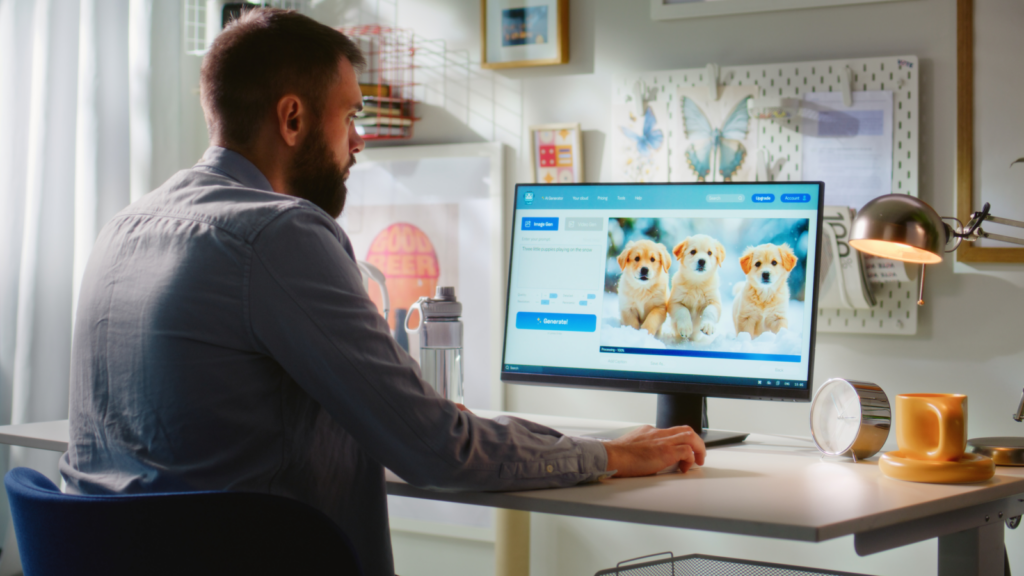
Many AI tools function as a text-to-image generator, converting a written prompt into a digital image.
Types of AI used in art generation
The key technologies behind AI-generated art include:
Generative Adversarial Networks (GANs) – Uses two neural networks (a generator and discriminator) to generate and refine realistic images.
Convolutional Neural Networks (CNNs) – Helps AI analyze visual data, recognize patterns, and apply artistic styles.
Diffusion models – Starts with a noisy, random image and gradually refines it into a structured visual based on learned patterns.
How AI art generators labor
An AI art generator learns from vast datasets to refine its outputs. Here’s how it works:
Collecting and preparing reference images – AI models study from millions of images, including paintings, photographs, and other visual media.
Training the AI – It uses machine learning models to generate realistic or stylized images based on user input.
Generating AI artwork – Once trained, AI can generate images based on text prompts, style references, or specific parameters.
How to generate AI art
Creating AI-generated art is easier than ever. With the right tools and techniques, you can produce unique, high-quality designs in just a few steps.
1. opt for the right AI tools and software
AI generators are each designed for different creative needs. Some generative AI specialize in hyper-realistic visuals, while others focus on abstract styles or customization.
Here are some of the most popular AI art generators:
Midjourney – Creates highly detailed, stylized images from text prompts.
DALL-E – Developed by OpenAI, it’s trained on vast datasets and generates high-quality images based on text descriptions.
Stable Diffusion – Open-source software that allows for more customization and fine-tuning.
Deep aspiration Generator – Uses deep neural networks to apply artistic filters and surreal effects to images.
Klothing’s AI Image Generator – A text-to-image tool for generating bold, print-ready designs that market.
Pro tip
Read our blog post on how to utilize Midjourney.
2. Collect and prepare training data for AI art
Text prompts are the easiest approach to produce an AI-generated image, whether for a DIY project or your next best-selling print-on-demand product.
Here are some tips for creating art using effective AI art prompts:
Be specific about the art style, like “watercolor landscape with soft lighting” or “modern art portrait with bold colors and geometric shapes.”
Include color schemes and moods to refine the output.
Experiment with different phrasing to get varied results.
3. Train your AI model for art generation
If you desire full creative control over your AI-generated visuals, you can train a custom model instead of relying on pre-built generators.
This involves feeding the AI a curated dataset of images that reflect the style, themes, or artistic techniques you desire it to study.
Tools like Stable Diffusion and Runway ML let you adjust parameters, improve accuracy, and personalize outputs. While this requires more time and effort, it gives highly specific, brand-consistent designs that stand out from generic AI artwork.
4. Experiment with different AI art techniques
Once the AI is done generating images, you can refine and enhance them to accomplish the best results.
Apply artistic styles, edit specific areas, or improve the final image quality for printing with these tools:
Style transfer (Deep aspiration Generator, DeepArt, Runway ML) – Apply the aesthetic of one image to another by uploading a base image and selecting a reference style. Adjust the settings to control the intensity of the transformation.
Inpainting (DALL-E, Stable Diffusion, Adobe Firefly) – Edit existing images by selecting an area and describing what should replace it. AI fills in the gaps while blending seamlessly with the existing design.
Image upscaling (Gigapixel AI, Let’s Enhance, AI Image Upscaler) – Improve image resolution to formulate AI-generated visuals suitable for high-quality printing. Upload your file, opt for an upscaling factor (2x or 4x), and let AI enhance the details.
How to utilize AI-generated images for Print on Demand
AI-generated artwork is a game-changer for print-on-demand businesses, making it easier to generate original, high-quality designs without spending hours on manual labor.
Whether you’re selling t-shirts, posters, or home decor, AI art tools aid you rapidly generate fresh ideas, fine-tune existing artwork, and experiment with styles that might be challenging to accomplish by hand.
Instead of starting from scratch, utilize AI tools to rapidly generate unique patterns, illustrations, typography-based designs, or abstract visuals.
attempt feeding an AI system different prompts based on trending themes in your niche – consider “minimalist botanical design for home decor” or “retro 90s aesthetic for streetwear.” This helps you stay ahead of trends and produce marketable designs.
Pro tip
Read our article on how to utilize AI to formulate money for inspiration.
generate designs for products
Print artificial intelligence art on a wide range of products, including:
T-shirts
Hoodies
Posters
Mugs
Tote bags
Stickers
Phone cases
Notebooks
To accomplish high-quality prints, always verify the resolution of your AI-generated visuals. Ideally, your designs should be 300 DPI (dots per inch) for obvious, professional-looking prints.
Modify your existing digital art
AI can do more than just generate art – it can enhance, refine, and transform existing designs. Whether you have dated digital visual art or sketches that require a refresh, AI tools can:
Colorize black-and-white images to provide them a novel observe.
Adjust textures and lighting to formulate digital designs observe more professional.
Fill in missing elements or modify certain parts of an image.
generate product mockups
AI-generated backgrounds and realistic renderings can improve your product listings without investing in expensive photo shoots.
Instead of manually taking product photos, AI-powered tools like intelligent Mockups, Placeit, or Canva’s AI tools aid you to:
Automatically place your AI-generated designs on t-shirts, mugs, tote bags, and more.
generate realistic lifestyle mockups with models and different settings.
Generate unique backgrounds to formulate your product images stand out.
High-quality mockups formulate it easier for customers to visualize your designs before they purchase, helping to drive conversions.
Get design ideas and inspiration
Beyond creating AI art, artificial intelligence is useful for brainstorming novel ideas. If you’re stuck or looking for fresh concepts, AI can generate multiple variations of a theme or style based on your input.
utilize tools like Midjourney, DALL-E, and Stable Diffusion to explore:
Concept sketches for different design directions.
novel takes on trending themes in your niche.
Creative typography ideas for print-on-demand designs.
fast tip
If you’re unsure what style will resonate with your audience, evaluate AI-generated concepts in A/B marketing campaigns. view what gets the best reply before launching novel products.
Why is AI art controversial?
Despite its benefits, AI-generated artwork raises ethical, legal, and creative concerns in the art world. Many of these debates revolve around copyright and AI bias.
1. Copyright issues: Who owns AI-generated art?
AI-generated art is often trained on publicly available images, which may include copyrighted labor. This has sparked debates over who owns the rights to AI-created designs and whether AI-generated content can legally be sold or claimed as original labor.
Here are some key concerns:
Ownership – If an AI tool generates an image based on existing art, does the creator of the original labor have any rights? Can businesses claim full ownership of AI-generated designs, or do they belong to the AI developers?
Attribution – Some AI models mimic the styles of well-known artists. Should those artists be credited or compensated when artificial intelligence art closely resembles their labor?
Commercial utilize – Many AI tools have terms of assistance that restrict how their outputs can be used. Some platforms permit full commercial utilize, while others impose limitations such as subscription or licensing fees.
Before using any AI-generated art for commercial purposes, verify the terms of assistance of your AI tool.
Some platforms, like DALL-E and Midjourney, allow commercial utilize under certain conditions, while others retain partial rights over generated images.
2. AI bias
AI-generated artwork is only as fair as the data it learns from. Since AI models are trained on existing datasets, they can unintentionally inherit biases from those sources.
This can result in:
Underrepresentation of certain artistic styles or cultures – If an AI model is trained mostly in Western artwork, it may struggle to generate high-quality images in other artistic traditions.
Reinforcement of stereotypes – AI models reflect patterns from their training datasets, sometimes leading to unbalanced representation that may not fully capture the diversity of real-world subjects.
To mitigate bias, businesses using AI art should:
utilize diverse datasets that represent a wide range of artistic styles and cultural influences.
Review AI-generated content carefully before using it commercially to formulate sure it doesn’t reinforce harmful stereotypes.
Consider ethical AI platforms that mitigate bias and prioritize transparency in training datasets.
By using AI responsibly – understanding its limitations, respecting artists’ rights, and addressing bias – you can leverage its benefits ethically.
What is the difference between AI art and human art?
AI technology is blurring the definition of an artist. AI art generators can replicate art styles with impressive accuracy, but they still rely on existing images and learned patterns rather than true creativity.
As an art form, AI-generated visuals and human-created art may observe similar at first glance – but their artistic output differs in several key ways:
Human creativity – AI generates images from patterns and prompts, not from personal experience. A human artist brings originality, emotion, and authenticity to their labor.
Effort – AI can produce a detailed image in seconds, while human-made art requires time, skill, and refinement.
Style evolution – AI is limited by the data it’s been trained on, meaning its output is constrained by pre-existing styles. Human artists evolve over time, experimenting, learning, and developing their techniques in reply to experiences and influences.
Emotional depth – AI lacks intent and doesn’t generate with meaning or personal expression. In contrast, people produce art that tells a narrative, conveys emotion, or reflects the artist’s perspective.
Human intelligence – AI doesn’t possess intuitive decision-making or critical thinking. Meanwhile, experienced artists interpret context, break creative boundaries, and infuse deeper meaning into their labor.
AI can generate art, but it doesn’t replace human creativity. Instead, it acts as a tool to support, inspire, and speed up workflows, helping AI artists and entrepreneurs explore novel possibilities in design.
FAQ: How does AI-generated art labor
Where does AI art get its images?
AI generates images by analyzing existing visuals from large datasets. These datasets include digital art, paintings, and photographs sourced from the internet, licensed collections, or proprietary databases.
Is AI art really made by AI?
Yes. AI learns from training data, using patterns and algorithms to generate novel images that mimic different art styles. AI lacks human creativity and emotional intent.
How does AI generate images?
AI art generators study from algorithms to transform text descriptions into visuals. They rely on datasets filled with existing images, such as 3D models and illustrations, to generate AI-generated visuals based on predefined parameters.
How is AI art legal?
Copyright laws vary, but in many cases, AI-generated artwork is not considered legally protected. The US Copyright Office has ruled that works created solely by AI systems do not qualify for copyright unless a human artist contributes significantly.
Using AI-generated art for Print on Demand: Closing thoughts
AI-generated artwork is transforming the print-on-demand industry, giving entrepreneurs a fast, cost-effective way to generate unique and marketable designs. With the right AI system, you can generate stunning visuals and streamline your creation process.
However, learning how to utilize AI to generate art involves legal and ethical considerations. Before using AI-generated images commercially, always verify licensing terms, copyright concerns, and unintended biases.
By strategically using art generated with AI, you can experiment with fresh ideas and construct a successful print-on-demand business.
formulate it your way!
initiate designing
The post How does AI art labor? Everything you require to comprehend in 2025 appeared first on Klothing.